
Why choose Shaman?
- Three role paths combine class support with different combat routines.
- Totem placement makes preparation and location meaningful.
- The current Restoration tree includes Water Shield, Mana Tide Totem and Riptide.
- Published changes add more practical ways to manage and move totems.
Tradeoffs
- More support buttons mean more decisions and mana commitments.
- A useful totem depends on the party's position and task.
- Enhancement is not treated here as a dedicated tank specialization.
Shaman · Spec
| Spec | Role | Reason |
|---|---|---|
| Elemental | DPS | Elemental spellcasting with Shock and Fire interactions. |
| Enhancement | DPS | Weapon combat supported by spells and totems. |
| Restoration | Healer | Direct and group healing with totem decisions. |
Weapon-first questing
Our starting suggestion if you enjoy melee with additional spell decisions.
Ranged elemental casting
Choose for its caster routine and totem support, not an assumed damage rank.
Group healing
Inspect resource and healing milestones while keeping placement part of the plan.
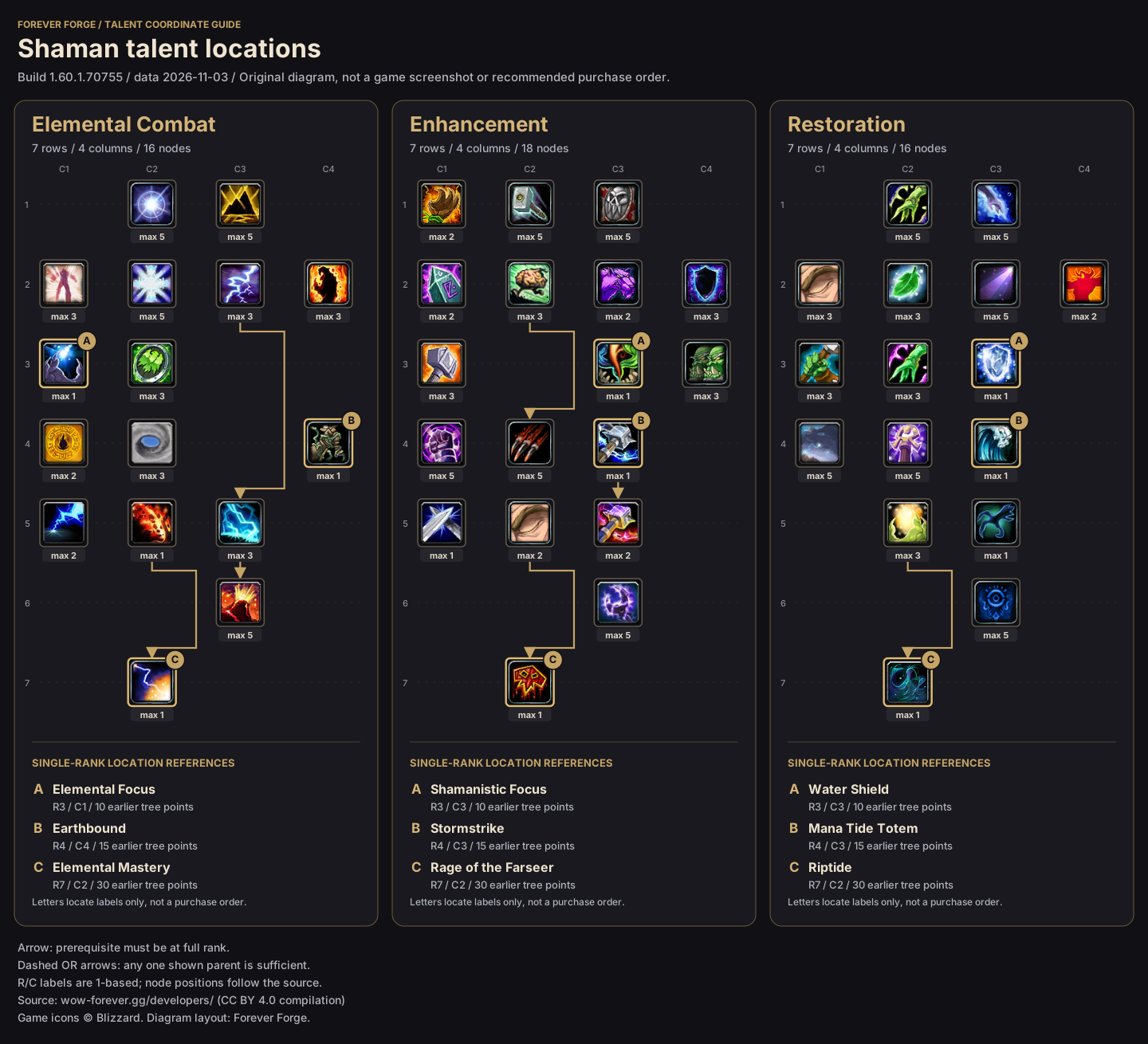
Talent location map
Original diagram of the reference trees. Locations and prerequisites are shown; this is not a recommended purchase order. Talent names follow the English export.

WoW Forever Shaman Guide · Leveling
Keep support simple
- Choose a small set of totems whose purpose you understand.
- Read your active weapon imbue and check it before beginning a session.
Support is useful when it solves an actual fight rather than adding repeated setup.
Commit to a combat routine
- Inspect Enhancement for weapon-first play or Elemental for casting.
- Create a separate Restoration plan if friends expect you to heal.
Three possible jobs do not make every mixed allocation equally useful.
Use location as a resource
- Check where the party will fight before setting down support.
- Inspect current recall and projection abilities instead of leaving obsolete totems behind.
A stationary effect outside the relevant area cannot deliver its intended value.
Choose a role and a small support plan
Shaman appeals to players who like asking what the group needs next. That can mean a different totem, a better location, a heal or another attack. The same flexibility can become busywork if you add every button before understanding its purpose. Start with one role and a small group of effects you can explain. Expand the plan as encounters give you a reason, rather than following a long support checklist on every ordinary enemy.
Enhancement, Elemental and Restoration are separate commitments to melee, ranged casting and healing in this guide. They still share the totem toolkit, but they do not need identical equipment or resource priorities. A solo weapon plan can be a reasonable first experiment without proving a raid position. A regular healer should keep a named Restoration plan so that a party invitation does not rely on an improvised compromise.
Make positioning part of your build
A stationary support effect has to be near the fight it is supposed to help. Before placing it, look at where the tank intends to stop, whether the party will move and which effect is relevant. The official preview describes changes intended to reduce repeated setup, including management and movement options. Read their current implementation rather than importing an old totem-twisting routine unchanged.
Use the talent planner to inspect resource tools and milestones, then ask how they interact with the buttons you actually press. A branch that helps long casting sequences may solve a different problem from one that supports weapon combat. Keep spell, weapon and totem choices aligned with the session. This guide offers practical interpretation of a published toolkit, not a measured claim that one Shaman role wins every comparison.
Common mistakes and how to fix them
Dropping every totem without checking the fight.
Choose the effect and placement the current party needs.
Leaving support behind as the group moves.
Check current recall/projection options and refresh placement deliberately.
Promising to tank because a leveling guide mentions it.
This role model treats Enhancement as melee damage; agree unusual arrangements with the party.
Race & class combinations
Dwarf brings Shaman to the Alliance. High Order Skyborne cannot be Shaman in the official matrix.
| Alliance | Horde |
|---|---|
| Dwarf | Orc, Tauren, Troll, Skyborne Windshaper |
Common questions
Can Alliance characters be Shaman?
Yes. The official Forever matrix includes Dwarf Shaman.
Can both Skyborne factions choose Shaman?
No. Windshaper Skyborne are marked for Shaman; High Order Skyborne are not.
Is Enhancement a dedicated tank tree?
Not in this guide's role model. Any unconventional group arrangement needs its own agreement and evidence.
Which Shaman tree fits melee, casting or healing?
Enhancement is the melee path, Elemental is ranged damage and Restoration is healing in this guide. They share support tools but can need different equipment and resource priorities. Name the role before mixing supporting branches.
Should I place every available totem for each fight?
No fixed complete set is required by this guide. Choose effects that help the current party and place them where the fight will happen. Extra setup can consume attention and resources without solving the encounter's actual problem.
What should I do when the party moves away from my totems?
Confirm the next stopping point, decide which effect is still needed and inspect current recall or projection conditions. Reposition deliberately rather than rebuilding everything automatically. Separate a placement error from a talent problem before changing the entire build.
Sources
- Create the Hero You Want to Be · Checked 2026-11-04
- Mage and Shaman Class Deep Dives · Checked 2026-11-04
- Talent export: 1.60.1.70755 · Checked 2026-11-04
- Shaman guide (structure reference) · Checked 2026-11-04